Why Choice Creates Challenge

When I entered the public speaking industry in the dot-com era it was through events agencies who supplied our services along with a wide variety of others. Presenters and ambassadors like me, plus branding, market messaging, scripting, client support, logistics, design, digital content, even mobile campaigns. The point was to give the customer a wide variety of choice, a menu of options to select from. I learned fast that too many choices creates confusion rather than clarity. Ever eaten at a Cheesecake Factory? 'Nuff said.
In my role, multiple choices meant submitting as many as a dozen speaker options to a corporate client for them to select from. To me, that never made sense. First, clients are too busy to sift through piles of possibilities and choose the "best" presenter for their needs. More people on the menu only meant wasted time and uninformed or random decisions.
Second, the client was paying the agency for their expertise. That included knowing the ideal speaker for a specific brand and job. Why offer eight options to someone not specialized in such things? It felt like passing the buck rather than confidently assigning the individual who would create maximum success for that unique event, then standing behind that selection. It was an early and valuable lesson: more often than not, choice stymies progress.
Freedom of choice isn’t
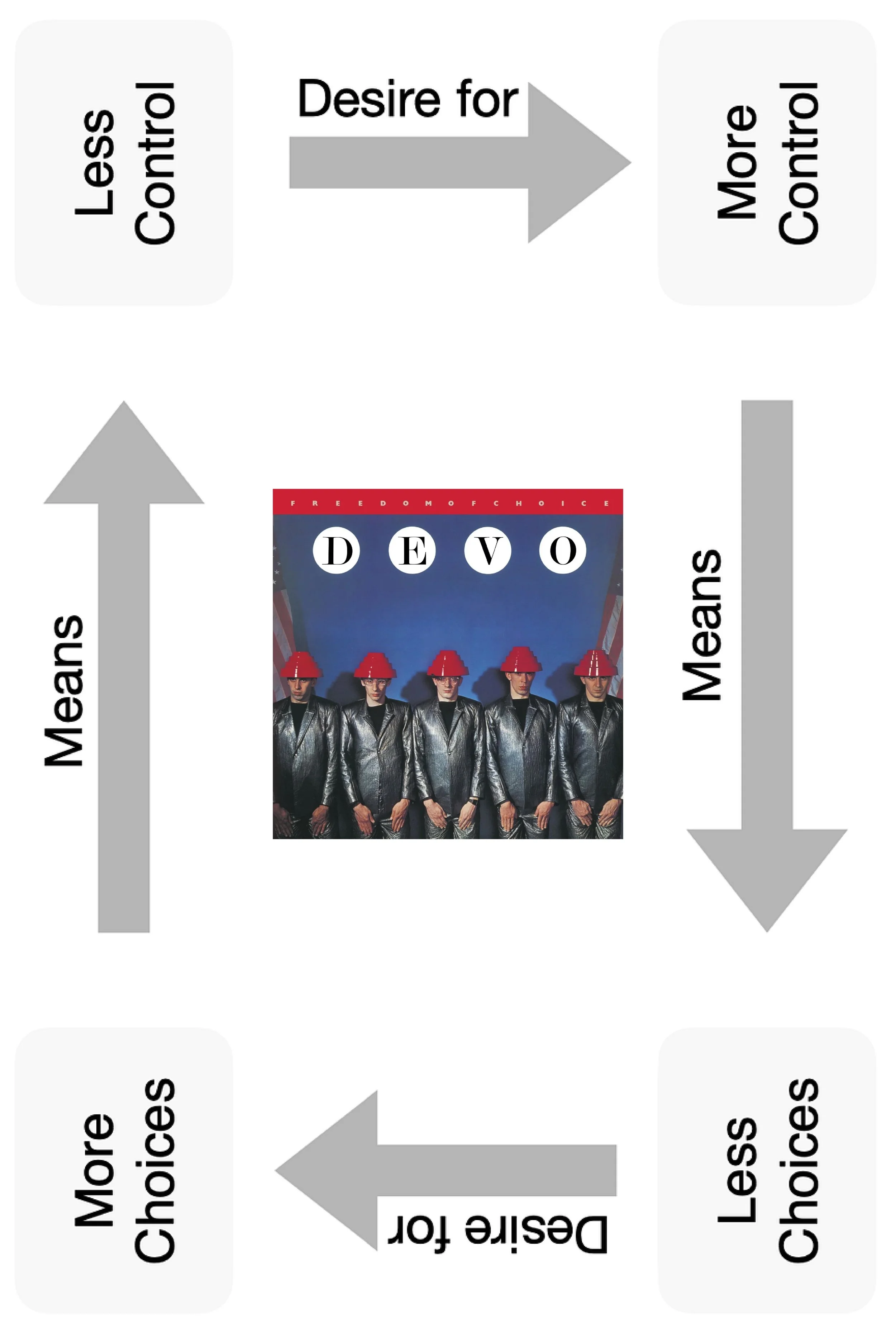
Devo's 1980 third album title track nailed the concept:
In ancient Rome there was a poem
About a dog who found two bones
He picked at one, he licked the other
He went in circles, he dropped dead
Freedom of choice is what you got
Freedom from choice is what you want
Consider a universal frustration. When considering a new car, buyers love that there are numerous similar makes and models on the market. They research, read blogs, watch influencer videos, crunch numbers, and narrow the field to 3-5 options. Then come test drives, sales pressure, lack of technical knowledge, confusion, internal conflict, and resulting stress. Meanwhile, top purchasing influences are simple: price fuel efficiency, and safety.
So why not just home in on the vehicle with the best MSRP, MPG, and safety rating and save the time and hassle? Simple: There might be something better out there. What if another car has more comfortable seats or a smoother ride? Maybe a different brand comes in nicer colors, or has a sweeter sound system. This one has an inline-4 but that one offers a flat-4 turbo. I don't really know the difference, but it's faster. But I want great fuel performance. But also great road performance. Choice becomes challenge. Too many options leads to insecurity we'll choose wrong. Analysis paralysis. In the end, we hope we didn’t make a mistake. Or choose not to choose and keep the old car.

Avoid if/and/or
Lather, rinse, repeat whenever too many options feel overwhelming instead of empowering. Dating, marriage, home purchase, what to cook for dinner, the right investment, right TV, right moisturizer or shampoo, which travel destination to visit and which to skip with limited time. No matter which decision we make, we're left with worry we made a mistake. Or that we're too ignorant or uninformed to select correctly.
As public speakers and team leaders, this is our challenge. An audience or executive doesn't want or need a multitude of choices. They trust us to give our seasoned and studied arguments for why our path is the right path, and why.
An if/and/or presentation weakens impact and muddies the water. Offering four ways to get to a winning destination only complicates decision making. True leadership picks the best option, presents it bravely and without reservation, and stands behind it backed by experience and expertise. And audiences love it. Fewer options, greater confidence.
Bottom Line
Sadly, I've fallen into the same choice trap with my own brand. I offer lots of different services that make marketing and promoting my company challenging. Is this guy a keynote speaker, a corporate spokesman, a coach, a trainer, a writer, a producer, a staffing service? Well, yes. Seems I never learned that lesson my first employers taught me.
But I'm always a communicator first, which narrows the story of what I do and why. It's from that angle I consider the real power of choice. For example, as a staffer, I never give clients five options; I tell them exactly who they want, and guarantee that single voice is is the only one they want and need. As a coach, I champion executives on the specific word or concept to improve and why committing to it will clarify their stance and lead directly to impact and import.
Any time multiple choices seem the wise strategy, stop. Your audience, client, or C-suite doesn't have the bandwidth, the insider knowledge, or the interest to wade through and select correctly from your overcrowded menu. That's what they pay you to do on their behalf. Narrow the selection. Tighten the script. Sharpen the presentation. Give them their very best option, and let them get moving.