What Churchill Knew About Winning an Audience
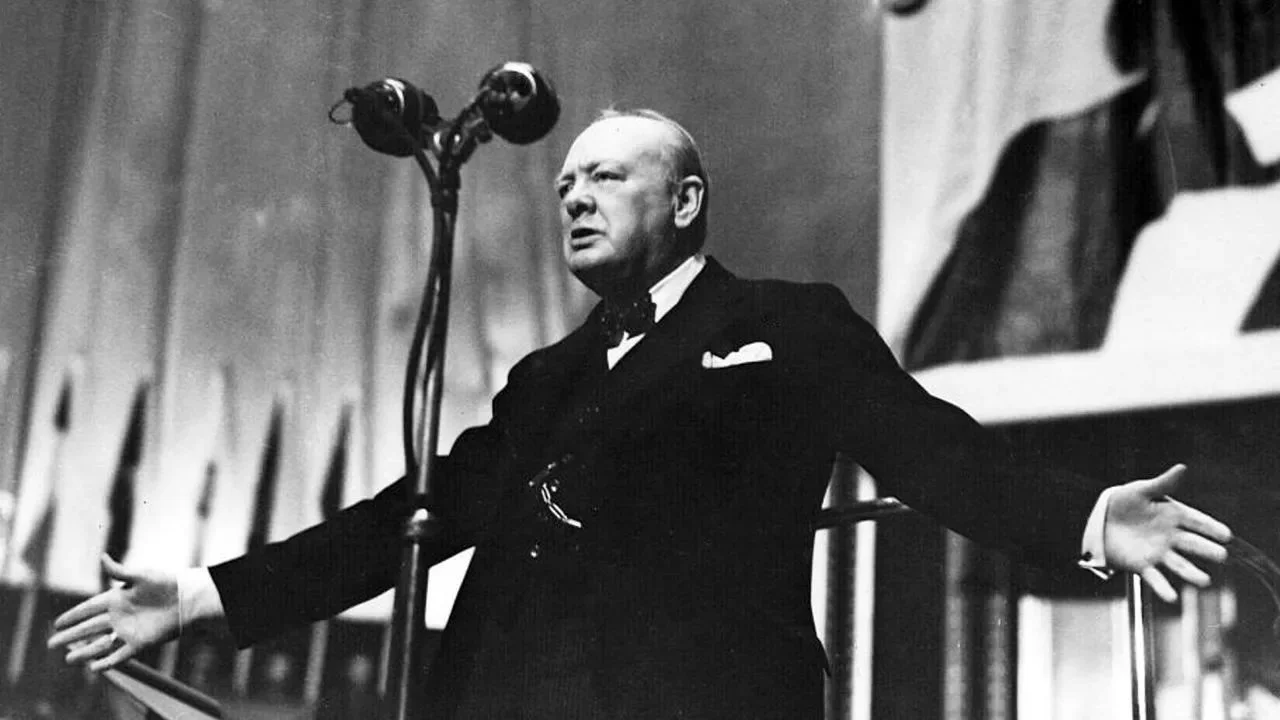
Writing about rhetoric as a young man, Winston Churchill argued that powerful oratory depends on several essential ingredients: precise language, rhythm, the accumulation of arguments, analogy, and genuine emotional conviction. Young Winston knew a thing or two about how to give a speech. But his theories also demand cautionary asterisks for the rest of us as public speakers. Here are Churchill’s five theories of successful public speaking.
1. Choose your words like they matter. Churchill believed in precision: finding the best possible word and, when appropriate, choosing short, familiar language rather than impressive-sounding vocabulary.
2. Make the words move. Churchill reminded us that a speech is meant to be heard, not read.
3. Build the argument. Churchill believed in accumulating arguments, stacking facts, ideas, and vivid images until they drove toward a specific and powerful conclusion.
4. Give people something they can picture. Churchill understood how to take something unfamiliar and explain it through something the audience already recognizes and relates to.
5. Believe what you’re saying. Before we inspire emotion, Churchill argued, the speaker must be moved by that emotion themselves.
Let’s see where this icon of oratory was spot on, or deserves a modern asterisk.
Our words and how they’re heard *

Choose your words like they matter. Smart speakers want people thinking about their clear, value-driven idea, not wondering what the heck “multidimensional organizational optimization” means. Clear language builds trust because it signals that the speaker understands the subject well enough to explain it simply.
* The danger is taking simplicity too far. An audience does not need every idea reduced to kindergarten vocabulary. Experts want substance. Oversimplifying complex issues can indicate to a savvy listener that the speaker may not understand the complexity themselves. Simple is powerful. Simplistic is suspicious.
Make the words move. Rhythm, cadence, repetition, pauses, and sentence length turn information into inspiration. A well-timed pause can make an audience lean forward. A carefully repeated phrase can make an idea stick. Varying pace and sentence length keeps listeners engaged.
* Such Churchillian rhythm can come across like theatrical imitation if it’s not organic and honest. Striding around stage, delivering every sentence as though civilization itself depends on your next PowerPoint slide, raises eyebrows and invites skepticism. A good story can’t be an over-rehearsed dramatic reading. Your delivery should sound like you, not like a historical reenactment.
Build the argument. People need a reason to care. A strong argument gives them one. Rather than throwing five unrelated points at an audience and hoping one survives, great leaders build momentum by establishing the problem, demonstrating why it matters, providing evidence, and showing what should happen next.
* The potential weakness is that accumulation can quickly become overload. More evidence does not automatically mean more persuasion. At some point, our audience gets saturated and frustrated. They stop thinking, “Wow, that's compelling,” and start thinking, “Wow, how many slides are left?” Churchill's principle works best when we give our audience just enough for one session and no more, and every argument earns its place.

Paint the Passion Perspective
Give people something they can picture. Any time we turn an abstract business problem into a traffic jam, a leaky bucket, or a badly organized kitchen junk drawer, suddenly people have something to visualize. Analogy creates understanding—and understanding creates confidence.
* But a clever comparison is not evidence. Analogies can undermine credibility if they become more memorable than the facts. There’s a risk an audience may remember a particularly vivid or funny story while forgetting the argument it’s meant to highlight. Analogy is used to illuminate reality, not replace it.
Believe what you're saying. Perhaps Churchill's most important insight was that a speaker must genuinely feel and believe the message. Audiences will smell out manufactured enthusiasm a mile away. Authentic conviction builds trust because people sense that the speaker has something at stake.
* Still, conviction can have a dark side. Speakers who are too convinced can sound arrogant, ideological, or unwilling to consider another perspective. Confidence attracts an audience, but certainty without humility can repel one. Sharing passion for our topic and boldly insisting our way is the only way are two very different rhetorical approaches to presenting.
Bottom Line
Churchill's theory is brilliant because it respects the fundamentals: choose words carefully, make them memorable, build a persuasive argument, create vivid mental pictures, and speak with genuine conviction.
But even the seemingly “right” words, copy-pasted from a website or Legal-approved white paper, can undermine our authority as speakers. Careful argument, confident delivery, compelling imagery, and impassioned delivery all matter. But without obvious authenticity, they won’t create credibility.
Modern audiences want something Churchill knew, but that every speaker must discover for themselves: give people a reason to believe you, a reason to care, and a reason to remember. Your content is not the key message; what you make people believe—and do—is. Make that truth your winning asterisk.